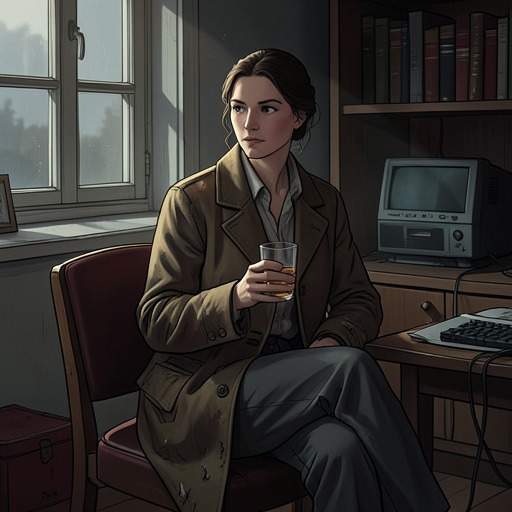
Smilla Jaspersen—Juliane Christiansen
Smilla's Sense of SnowSmilla Jaspersen and Juliane Christiansen are bound together by Isaiah, whose death turns a guarded acquaintance into a relationship of grief, trust, and practical care. Juliane’s sorrow is exposed to public scrutiny, while Smilla responds not by keeping her distance but by standing beside her, searching her home for evidence, and asking to see the papers through which Juliane’s life has been documented by the authorities.
Grief and Recognition
At Isaiah’s funeral in Copenhagen, the December snow and darkness make the gathering feel as though it belongs in Greenland. Juliane has taken disulfiram that morning and is confronting her grief almost sober; her whimpering draws disapproval from the pastor and verger, just as Smilla’s black net stockings invite judgment. Smilla understands both choices as tributes to Isaiah and to the cold, rather than signs of disrespect. Their shared position in the ceremony is established through this difference between how they are seen and what their actions mean to them.
When the pastor throws earth onto the coffin and the mourners are expected to leave, Juliane falls to her knees and presses her face to the ground. The other women leave her alone. The scene gives her grief room instead of correcting or managing it. At the same moment, Smilla recognizes an inward obligation: she has been bound by a pact with Isaiah not to abandon him. That insight helps explain why her connection to Juliane becomes active rather than merely sympathetic. Remaining loyal to the dead boy also means attending to the mother left behind.
The relationship is not presented as effortless closeness. After an encounter with the forensic investigation, Smilla sees Isaiah’s small body in the basement morgue and leaves without looking at the investigator. The weight of what she has witnessed is carried back into her dealings with Juliane, whose own grief is inseparable from the investigation Smilla is pursuing.
Trust in Private
Smilla has visited Juliane’s apartment before, but their usual visits have been confined to the kitchen and coffee. She has treated Juliane’s privacy as something to respect, especially because Juliane’s life is already exposed. Now, however, Smilla feels an urgent responsibility: she believes someone has overlooked something. That change in purpose takes her from the familiar kitchen into the more intimate disorder of the apartment, where Juliane permits her to search.
The permission has a complicated background. Juliane has been on welfare and under the close scrutiny of public authorities for so long that she has largely stopped expecting privacy to be protected. Smilla’s search therefore depends on trust, but it also takes place in a setting where the boundary between personal life and official inspection has already been worn down. The domestic details—the piled clothes, the belongings Isaiah brought back from hospital, and the papers kept in envelopes—make the search feel less like an abstract investigation than an entry into a life under strain.
Among Isaiah’s returned possessions are his rain pants, sneakers, sweatshirt, underwear, socks, and a soft white stone he used for chalk. Juliane stands in the doorway crying and explains that the diapers were the only things she threw out. Isaiah sometimes wore them for a couple of days when his fear of heights worsened, and Smilla had once bought them for him herself. This detail joins the two women through a small, intimate history of care: Smilla knew one of Isaiah’s private difficulties, and Juliane has preserved nearly everything that remained of him.
Smilla puts an arm around Juliane’s shoulders before asking her to show the papers. The gesture accompanies, rather than replaces, the request. The documents matter because Smilla suspects an omission, but asking to see them also requires Juliane to let her into a part of her life that has been shaped by official demands.
Papers, Care, and Unequal Exposure
Juliane’s records are stored not in a filing system but in seven greasy envelopes. They contain the accumulated proof of her dealings with institutions: alcoholism-clinic appointment slips, her birth certificate, tax cards, bank statements, health-insurance certificates, a passport, electricity receipts, credit-agency letters, and pension slips showing a monthly payment of 9,400 kroner. Even bakery coupons have their place among the documents. Smilla observes the contrast between the ordinary drawer or folder in which others might keep their papers and Juliane’s makeshift archive of existence.
The papers also illuminate a wider imbalance. Smilla understands that bureaucracy is especially difficult for many Greenlanders, and the envelopes embody that burden in a concrete, personal form. Juliane’s life is made legible to the state through forms and correspondence even as the arrangement of her papers reflects limited means and limited control. Smilla’s request is therefore both investigative and relational: she is trying to find what has been missed without pretending that the official record is a neutral or complete account of Juliane’s life.
Juliane’s relationship with alcohol forms another part of their uneven circumstances. Smilla describes her as inhibited and silent when sober, but lively when drunk; at the funeral, disulfiram and alcohol leave her grieving through the effects of poisoning. Smilla’s response is not to reduce Juliane to that condition. She acknowledges the drinking and its consequences while continuing to treat her as someone whose testimony, possessions, and grief deserve attention.
Reliance and Its Limits
Later, Smilla takes cod liver from Juliane’s refrigerator and half a bottle of Halcion pills from her bathroom. Juliane allows her to forage and has given up asking questions about almost everything. The medicines are part of a precarious exchange: Juliane sells Halcion to drug users and uses the proceeds to buy medicine of her own that is subject to customs duty. Smilla’s ability to take what she needs rests on an intimacy that is real, but also on Juliane’s exhaustion and resignation.
As Smilla leaves, Juliane shouts that she has forgotten her. The protest complicates any easy account of the bond as simple mutual comfort. Juliane lets Smilla enter her home and take what she needs, yet she can also feel abandoned by the person she has trusted. Smilla’s movements through the investigation repeatedly pull her away from the apartment; the shouted accusation gives that separation a voice and shows its cost to Juliane.
At another departure, after the women have not spoken to each other, Juliane reaches for Smilla’s hand as she is about to close the taxi door. She calls Smilla a great lady, speaking as though she were describing someone who is not present. The gesture and the indirect compliment confirm affection and admiration, but their form keeps some distance in place: Juliane praises Smilla while momentarily talking around her, just as the relationship moves between closeness and separation.
A Bond Shaped by Smilla’s Background
Smilla’s understanding of Juliane is shaped by a childhood in Greenland and by her awareness of how little can be conveyed by explanation alone. She recalls Inuit accounts and practices that unsettle rigid ideas about gender, and describes her mother as both a woman who gave birth and cared for domestic life and a hunter who shot, paddled a kayak, and hauled meat. These memories do not make Smilla a spokesperson for Juliane, but they help explain why she resists judging people by a single outward category or by the standards of Danish institutions.
Her childhood knowledge is practical as well as reflective. Smilla remembers hunting, hunger, and the experience of taking birds from their nests before allowing them to rise and escape. She also describes the importance of movement and spatial freedom: in her recollection, her family was rarely indoors, and staying in one place for long was unthinkable. In Copenhagen, the locked room becomes an especially powerful image of punishment and confinement. These experiences help clarify why Smilla approaches Juliane through attention to lived circumstances—her habits, home, papers, and grief—rather than through an abstract judgment of her character.
Smilla later reflects that another culture can be understood only by living within it, learning its language, and accepting the limits of what can be explained. That principle echoes in her dealings with Juliane. She does not resolve Juliane’s life into a diagnosis or a case file; she enters the apartment, listens to what Juliane shows and says, and acts on the conviction that something important has been overlooked. The relationship’s significance lies in that practical form of recognition: care means staying attentive to a person whose grief is exposed, whose privacy has already been eroded, and whose connection to Isaiah cannot be separated from the search for what happened to him.